
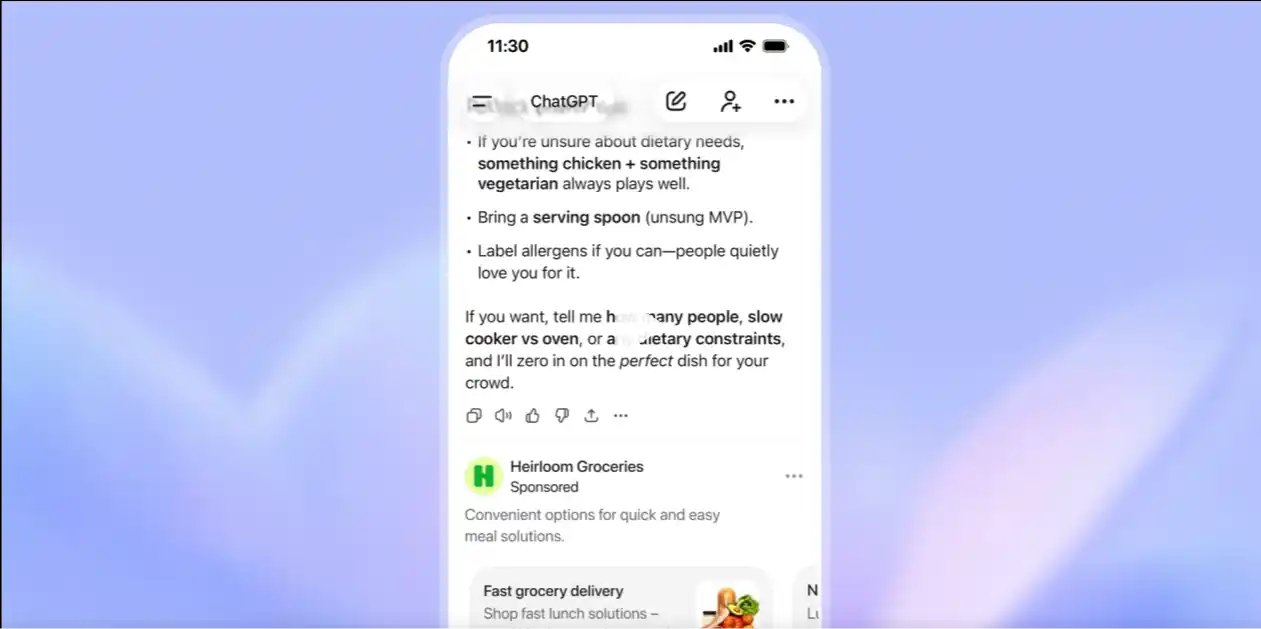

OpenAI dropped ads into ChatGPT today. Not testing. Not “exploring options.” Actual live advertisements rolling out to free and Go-tier users across the U.S. right now.
The company announced the move this morning—February 10, 2026—confirming what leaked screenshots had been hinting at for weeks. If you’re using ChatGPT without paying, you’re now part of the ad-supported internet. Welcome to the club.
How ChatGPT Ads Actually Work
The format isn’t what most people expected. No banner blindness. No sidebar clutter. ChatGPT ads appear directly in the conversation flow as “sponsored” messages that look almost identical to regular responses.
You ask about dinner recipes? You might see a HelloFresh pitch. Shopping for headphones? Sony’s marketing team wants a word. The ads are labeled “sponsored” and visually separated from ChatGPT’s actual answers, but they’re sitting right there in your chat thread.
OpenAI’s matching system pulls from three data points:
- What you’re discussing right now
- Your past conversations
- How you’ve interacted with previous ads
Researching vacation spots in Thailand? Expect travel insurance or booking platform ads. Asking about Python tutorials? Coursera’s probably in the queue.
What You Need to Know:
- Ads only hit Free and Go subscription users
- Plus, Pro, Business, Enterprise, and Education accounts stay ad-free
- Advertisers don’t see your actual chats or personal details
- You can dismiss ads, check why you saw them, or delete ad data anytime
Who Sees Ads And Who Doesn’t
The dividing line is simple: pay or see ads. ChatGPT Plus ($20/month) and Pro users get the clean experience. Everyone else gets the sponsored suggestions.
There’s one weird middle option OpenAI buried in the announcement: Free-tier users can opt out of ads entirely if they’re willing to accept fewer daily messages. No price tag mentioned. No specifics on what “fewer” means. Just a vague trade-off between ad tolerance and usage limits.
That’s the kind of detail that’ll matter once people actually try it and realize “fewer messages” might mean three conversations per day instead of unlimited.
The Privacy Angle
OpenAI’s being unusually specific about what advertisers can’t access. Your chats? Private. Your chat history? Private. Your memories? Private. Personal details? Private.
What advertisers do get: aggregate numbers. How many people saw the ad. How many clicked. Basic performance metrics that don’t identify individual users.
The company also confirmed ads won’t appear for users under 18 (either confirmed or predicted age) and won’t show up in conversations about health, mental health, or politics. Those guardrails might expand as OpenAI “learns from the test,” but for now, sensitive topics stay ad-free.
What This Means for ChatGPT’s Answers
OpenAI’s making a big deal about answer independence. Ads don’t influence what ChatGPT tells you. The response you get is still optimized for helpfulness, not advertiser cash.
That separation matters more than it sounds. If you ask “what’s the best smartphone under $500” and ChatGPT starts shilling for whoever paid the most, trust collapses overnight. OpenAI knows this. The ads sit separately from the organic answer—not mixed into the response itself.
When you see a sponsored message, it shows up after ChatGPT gives you its actual take. The ad is clearly labeled. It’s visually distinct. You’re not supposed to confuse the two.
Also Read This
Whether that holds up under pressure—when advertisers start complaining their products aren’t getting mentioned in the organic answers—that’s the real test.
Real-World Takeaway:
- ChatGPT’s answers stay unbiased (according to OpenAI)
- Ads appear separately, not mixed into responses
- Matching happens via conversation topics, not search keywords
- Users control ad personalization and can delete ad data
The Ad Controls Nobody’s Talking About Yet
OpenAI built a surprisingly detailed control panel for this. You can:
- Dismiss individual ads
- See why you got a specific ad
- Delete your entire ad history with one tap
- Turn off ad personalization completely
- Manage whether ChatGPT uses past chats and memory for ad targeting
That last one’s interesting. If you disable it, ChatGPT only matches ads based on your current conversation—not everything you’ve ever discussed. Less creepy targeting, possibly less relevant ads, depending on your perspective.
The settings live somewhere in your account preferences (OpenAI’s announcement didn’t specify the exact menu path, because of course it didn’t). Expect tutorials to flood YouTube by tomorrow.
What Happens Next
This isn’t a test phase anymore. OpenAI’s calling it a test, but when you’re rolling ads out to every free user in the U.S., that’s a launch. Tests are small. Tests are limited. This is the new normal.
The company’s promising to “learn and listen” before expanding internationally or adding new ad formats. Translation: if Americans tolerate this without mass exodus, ChatGPT ads go global.
For businesses, OpenAI’s opening the doors slowly. Right now, it’s an invite-only advertiser program. If you’re a brand that wants in, you sign up at openai.com/advertisers and wait for approval. No public pricing. No self-serve dashboard. Just “we’ll contact you if we think you’re a fit.”
That’ll change. Self-serve ad platforms are too lucrative to ignore. Give it six months and we’ll probably see a full Google Ads-style interface where anyone with a credit card can run ChatGPT campaigns.
What to Watch:
- User reaction over the next 2-4 weeks initial tolerance vs. long-term annoyance
- Advertiser demand and pricing transparency
- International rollout timeline
- Competitive response from Google Gemini and Microsoft Copilot
Bottom Line
ChatGPT ads launched today, and if you’re using the free version, you’re now part of the ad economy. The format is conversational, the targeting uses your chat history, and the privacy promises sound solid—at least on paper.
Your options: tolerate the ads, upgrade to Plus for $20/month, or opt into a usage-limited free tier without ads (details TBD). No wrong choice. Just different levels of patience with how AI companies monetize the future.
OpenAI framed this as supporting “broader access to AI.” Which is corporate-speak for “servers are expensive and we need revenue streams.” Fair enough. Free stuff costs someone something. Now you know who’s paying.

No comments yet. Be the first to share your thoughts!