
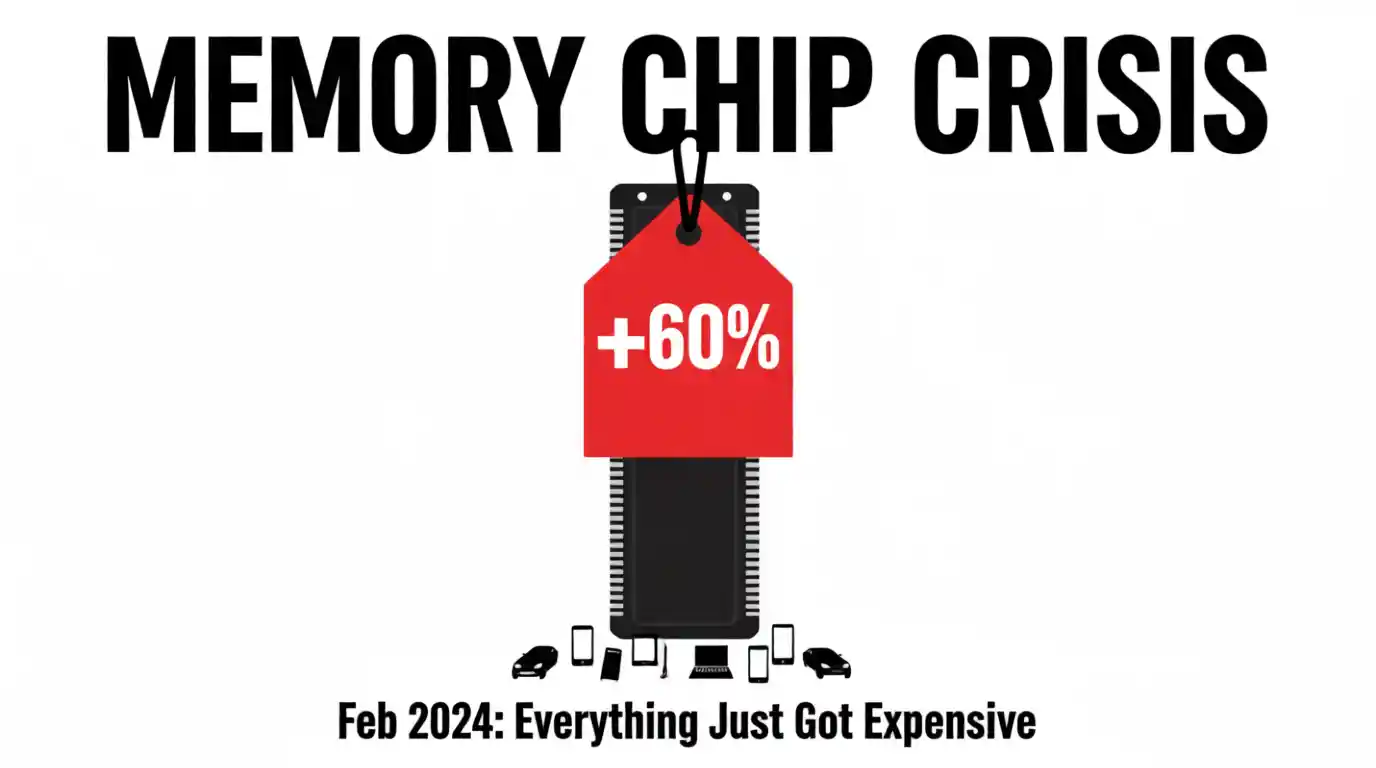

When I first covered the memory chip crisis back in February, I said prices were spiking and it wasn’t getting better soon. Five months later, I wish I’d been wrong. I wasn’t. If anything, the numbers that looked alarming in February look almost quaint next to what’s happened since — and now the price increases aren’t just showing up in DRAM contract sheets, they’re showing up on Apple’s own pricing page.
Here’s what’s actually changed since February, with the receipts.
Apple Just Confirmed What Everyone Feared
This is the update that matters most. Apple raised prices on MacBooks and iPads, telling customers directly that it’s passing along the cost of the memory shortage, and warning there could be more hikes coming. That’s not an analyst prediction anymore. That’s Apple, a company with more supply chain leverage than almost anyone on Earth, saying it can’t absorb this on its own.
Microsoft’s Xbox division is doing the same thing. Xbox prices are going up in August, and the division’s CEO, Asha Sharma, reportedly called the memory shortage the most severe hardware crisis in an internal message to staff announcing layoffs and restructuring. When a hardware exec at a company that size uses language like that internally, it’s worth taking seriously.
Nintendo Switch 2, the PlayStation 5, and the Valve Steam Deck have all gotten more expensive over the past few months too. This part of the story didn’t exist when I wrote the original piece — back then it was still framed as something that was going to hit phones and PCs. Now it’s hitting consoles, tablets, and premium hardware across the board.
The Numbers Got Worse, Not Better
My February figures were already bad. TrendForce’s finalized survey put Q1 2026 conventional DRAM contract prices at a 93% to 98% quarter-over-quarter increase — buyers signing contracts in January paid roughly double what they’d paid three months earlier. That’s well beyond the 55% figure I quoted back then, which turned out to be an early, conservative estimate.
Total memory industry revenue jumped 81% quarter-over-quarter to $97 billion in that same window.
There’s actually a small piece of good news buried in the recent data, and I want to be straight about it rather than just doom-loop the update. TrendForce now projects Q3 2026 conventional DRAM contract prices to rise 13% to 18% quarter-over-quarter, and NAND 10% to 15% — still increases, but a real slowdown from the 60%-plus jumps of Q2. The reason isn’t that supply improved. It’s that consumer electronics makers have basically hit a wall on how much cost they can pass on to shoppers before people stop buying. Memory is still scarce; buyers are just tapped out.
Don’t read that as relief, though. Micron, SK Hynix, and Samsung are still steering their best capacity toward AI customers, and Samsung and SK Hynix have both told investors they don’t plan to expand consumer-focused capacity aggressively. ADATA’s chairman is now warning of another 20-30% DRAM jump and 35-40% NAND jump for Q3 specifically on the consumer side, separate from TrendForce’s more moderate industry-wide figure — a reminder that the “slowdown” number is an average, and what you personally pay depends heavily on which segment of memory your device uses.
Cars Are Now Part of This Story Too
My February piece mentioned Ford vaguely warning about “component constraints.” Since then, Ford’s CFO Sherry House has put a real number on it: DRAM and inflation pressure are expected to add roughly $1 billion in costs to Ford in 2026 alone. That’s not a hedge-your-bets earnings-call soundbite anymore, that’s a company doing the math out loud.
Micron’s own estimates show why this hit automakers harder than most people expected. The average vehicle used about 90GB of combined DRAM and NAND as of recently, and that figure is projected to climb toward roughly 278GB per vehicle as ADAS, digital cockpits, and always-on connectivity keep expanding. Automotive DRAM prices specifically jumped as much as 450% between September 2025 and January 2026, according to Automotive News reporting — a steeper and more specific figure than anything I had in the original piece.
Toyota and Honda are now reportedly locking in longer-term supply agreements with chipmakers directly, which tells you how seriously the industry is treating this — automakers don’t usually go around chip fabs unless the usual channels have stopped being reliable.
Who’s Still Winning, Who’s Still Losing
The shape of this hasn’t changed much since February, but it’s sharpened. Samsung, SK Hynix, and Micron remain the clear winners — SK Hynix has said its entire 2026 production is already sold out in what the company is calling a “supercycle.” Micron has described the bottleneck in similarly stark terms.
On the losing side, the list has grown more specific. IDC’s analysis singles out thin-margin phone makers — brands like Xiaomi, Transsion, Realme, Oppo, Vivo, and Honor — as most exposed, since they don’t have Apple or Samsung’s cash reserves or long-term supply agreements to cushion the blow. Global PC shipments are now projected to fall over 10% in 2026, and smartphone shipments are expected to see their steepest annual decline on record, according to IDC figures cited across multiple recent reports.
What This Means If You’re Shopping Right Now
My advice from February mostly still holds, but I’d sharpen a couple of points given what’s happened since.
If you’re planning a big purchase — laptop, phone, even a car — the data increasingly suggests prices aren’t coming down before 2027 at the earliest, and some analysts now think certain segments won’t see 2024-level pricing again at all. Buying sooner rather than later is still reasonable advice if you actually need the device.
Consider a lower memory tier if your use case allows it. An 8GB phone or a 256GB laptop instead of stepping up a tier can meaningfully soften the price hit this year, even though that felt like backwards advice a year ago. If you’re weighing configurations, our guide on choosing the right laptop walks through which specs are actually worth paying up for and which aren’t.
The refurbished and one-generation-old market is genuinely more attractive right now than it’s been in years, since older inventory hasn’t fully caught up to new pricing yet. If you’re building or upgrading a desktop instead of buying new, it’s also worth checking current PC build guidance before you lock in a parts list, since RAM and SSD pricing swings can change what configuration makes financial sense week to week.
The Bottom Line, Updated
Back in February, this was a chip-industry story that hadn’t fully reached consumers yet. It has now. Apple’s confirmed price increases and Xbox’s announced August hike are the clearest signal yet that no manufacturer, however large, is fully shielded from this anymore.
The Q3 slowdown in the rate of increase is real, but it’s a deceleration, not a reversal — memory is still getting more expensive, just not quite as violently as it was in Q1 and Q2. Most credible forecasts, including IDC and Counterpoint Research, still point to relief not arriving in a meaningful way until sometime in 2027, and even then it may be partial.

No comments yet. Be the first to share your thoughts!