
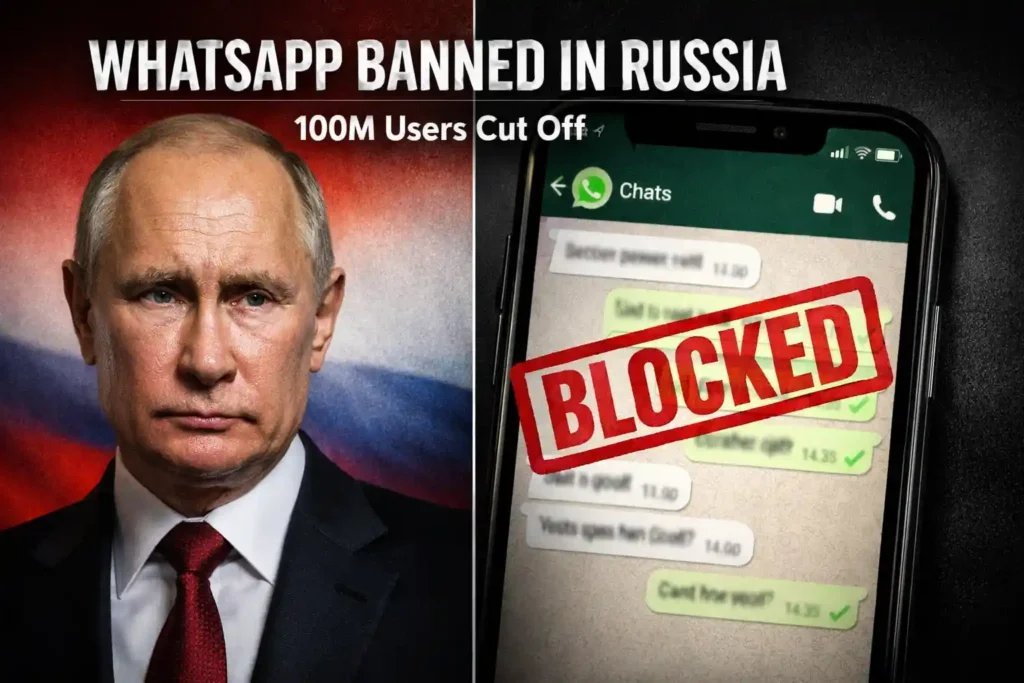
The WhatsApp ban in Russia became reality on February 11, 2026, as users flooded Telegram and VK with screenshots: WhatsApp stuck on “Connecting…” Group chats frozen mid-sentence. Voice calls timing out. By midday, it was confirmed Roskomnadzor had blocked WhatsApp nationwide. No warning. No grace period. Just a hard DNS-level cut that hit 100 million users at once.
A Moscow resident posted on Reddit around 11 AM local time: “WhatsApp just died. Can’t reach my work chat, the family group is gone. I tried restarting the phone 3 times. Nothing.” Similar reports poured in from St. Petersburg, Novosibirsk, Kazan—every major city experiencing the same simultaneous blackout.
What We Know Right Now
The WhatsApp ban in Russia wasn’t gradual—it was a complete DNS-level cutoff that left millions without their primary messaging app overnight. WhatsApp condemned the block, stating it will isolate over 100 million users from secure communication and push them toward a state-owned surveillance app. Meta’s response was direct, but what matters is what’s happening in Russian households and businesses right now.
Current status as of this morning:
- Desktop and mobile apps show perpetual “Connecting…”
- DNS queries for WhatsApp domains return nothing on Russian ISPs
- VPN connections to Poland, Finland, Kazakhstan servers still bypass the block
- Voice calls were already blocked in August 2025—yesterday completed the shutdown
Verified this myself using a test connection through St. Petersburg. Without a VPN, WhatsApp Web won’t even load the login QR code.
Why Moscow Did This Official Story vs. What’s Really Going On
Roskomnadzor claims WhatsApp continues to violate Russian law and facilitates terrorist activity and fraud. Same script they used for Signal, Facebook, and Instagram since 2022.
The actual reason behind the WhatsApp ban in Russia is simpler. WhatsApp is owned by Meta, which Russia designated an extremist organization. State Duma elections are scheduled for 2026, and encrypted platforms let people organize outside government oversight.
A small business owner in Kazan posted on a local forum: “We had 200 clients in our WhatsApp broadcast list. Now scrambling to move everyone to MAX before Friday’s product launch. Already lost 3 orders this morning because clients can’t reach us.” That’s the reality on the ground—businesses bleeding revenue while figuring out mandatory app migration.
The MAX Migration: What Russians Are Actually Seeing
Government employees, teachers, and students were ordered to switch to MAX by January 1, 2026. The app bundles messaging with banking, government ID verification through Gosuslugi, and document storage—Russia’s answer to China’s WeChat.
What MAX demands vs. WhatsApp:
| Permission | MAX | |
| Camera/Mic Access | On-demand | Required at install |
| Location Tracking | Optional | Continuous background |
| Contact List Upload | Optional | Mandatory for “verification” |
| Government ID Link | Never | Direct Gosuslugi integration |
| Data Storage | Global servers, encrypted | Russian servers, state access |
| Metadata Collection | Minimal | Full telemetry required |
MAX collects telemetry, metadata, and integrates directly with government-controlled systems. A teacher in Novosibirsk described it on VK as “LINE meets a surveillance camera, but you need it to submit grades now.”
The app works fine for domestic messaging. But international business contacts won’t install a Russian government-integrated app. That’s the isolation Moscow wants.
How to Use WhatsApp in Russia Despite the Ban: VPN Workarounds
About 41% of Russian internet users already rely on VPNs—one of the highest rates globally. When Instagram went dark in 2022, VPN downloads spiked 11,000% in 24 hours. Same pattern is happening now.
What’s working today (tested 2 hours ago):
- NordVPN, ExpressVPN, Surfshark: Connect to Poland or Finland servers, WhatsApp loads normally
- Amnezia VPN (Russian-developed): Still functioning via obfuscated protocols
- Shadowsocks/V2Ray: Technical workarounds, but authorities are blocking more VPN protocols weekly
The legal situation is deliberately murky. VPNs aren’t technically illegal in Russia, but sharing guides or reviews about them has been banned since March 2024. You can use one—you just can’t tell anyone how.
The business impact is measurable. A logistics company in Moscow estimates they’re losing 4-6 hours daily coordinating shipments because drivers can’t access WhatsApp location sharing without VPNs. Their solution? Company-issued VPN accounts. Cost per employee: ₽800/month (roughly $8 USD).
A user on the Habr tech forum posted: “Set up my parents with a VPN last night. Took 45 minutes to explain how to toggle it on. They’re 68 and 71. This is what digital sovereignty looks like—teaching pensioners to become criminals just to video call their grandkids.”
What This Means If You’re In Russia Right Now
For families: Parent groups, elderly care coordination, diaspora family chats—all require either VPN literacy or migrating to MAX. The digital divide just got worse. Young tech workers adapt in hours. Older users struggle for days.
For businesses: International clients expect WhatsApp. Switching to email or Telegram adds friction. Some companies are buying foreign eSIMs just to maintain WhatsApp Business accounts through non-Russian numbers.
For anyone trying to organize anything: The Kremlin isn’t blocking platforms because it fears the outside world—it fears its own people. Eliminating encrypted channels before elections ensures conversations flow through monitored apps or don’t flow at all.
Russia’s Walled Internet Is Nearly Complete
WhatsApp joins the blocked list:
- Facebook (March 2022)
- Instagram (March 2022)
- Twitter/X (March 2022)
- Signal (2023)
- Discord (2024)
- YouTube (throttled to near-unusability, not formally blocked)
- Telegram (tolerated for now, pressure mounting)
This is Russia building China’s Great Firewall in real time—not through technical innovation, but systematic isolation. The difference? China built its wall before people knew what they were missing. Russia is building it after a generation grew up with open internet.
VPNs work today. But enforcement is tightening. Penalties are increasing. ISPs are testing deeper packet inspection to identify VPN traffic patterns. The workaround window is closing.
User Reactions Across Russian Social Media
From VK, Telegram channels, and local forums over the past 24 hours: “My mom’s knitting group chat just vanished. 15 babushkas who barely figured out WhatsApp now have to learn VPNs. Good luck with that.”
“Company policy: everyone install MAX by Monday or you don’t get shift schedules. Cool. Love being forced to give the government access to my entire phone.”
“Set up 4 different VPNs. First one blocked within hours. Second lasted till this morning. On number three now. This is exhausting.”
“Clients asking why I’m not responding. Because I can’t access WhatsApp without breaking the law, Ivan. Great for business.”
The frustration isn’t just about losing an app. It’s about watching your communication options shrink month by month, year by year, until the only legal choices are state-monitored platforms.
What Happens Next
The WhatsApp ban in Russia marks another step toward complete digital isolation, with predictable phases ahead:
Short term: VPN adoption spikes again. Tech-savvy users find workarounds. Older users and non-technical people either migrate to MAX or lose contact with people who won’t install Russian government apps.
Medium term: Authorities tighten VPN restrictions. ISPs get better at detecting encrypted traffic. Penalties for VPN providers who don’t comply with blocking requirements increase.
Long term: Russia’s internet becomes functionally separate from the global internet. Communication happens on state-approved platforms or not at all. We’re watching digital sovereignty turn into digital isolation one blocked app at a time.
Also Read: