
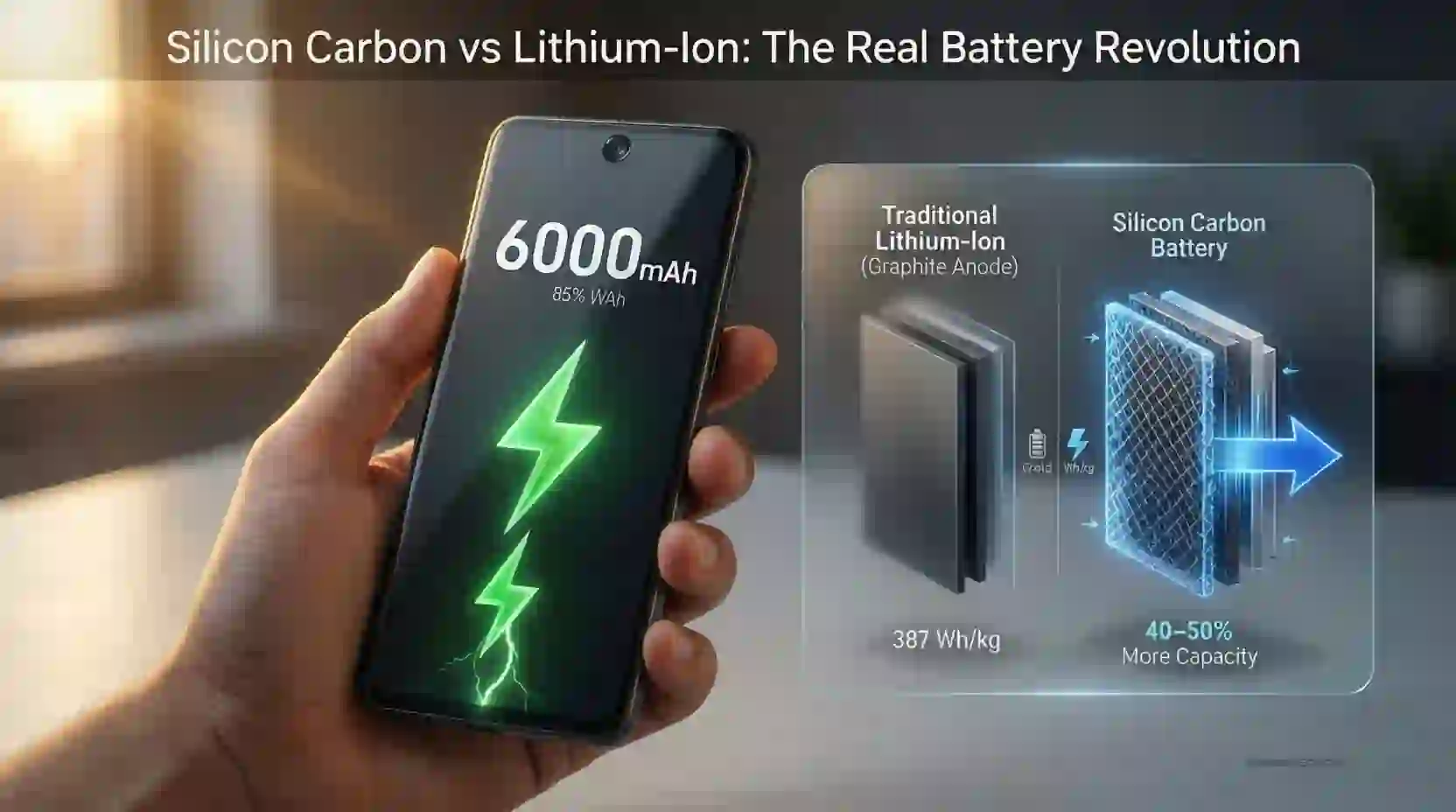

Have you noticed that now smartphones started coming with Silicon-Carbon batteries instead of traditional Lithium Ion batteries. It’s not just a small change, it’s a game changer that means your next phone packs double the battery life in a package that’s just half the size and this isn’t some far off science fiction promise. Silicon Carbon battery smartphones are shipping today.
Not some idea floating around at some tech conference, nor are they prototypes being poked at in some lab somewhere . They’re actual phones you can go out and buy right now, although typically from Asian brands that manage to squeeze 6,000 to 10,000mAh batteries into shells that are thinner than the latest flagship. So what brought this on ? How does it actually work ? and should you care about the change?
What Is a Silicon Carbon Battery?
Think of it as lithium-ion’s smarter cousin. Traditional lithium-ion batteries—the kind powering your phone for the past decade—use a graphite anode to store lithium ions. Works fine. Stable. But graphite hits a hard ceiling: it holds one lithium ion per six carbon atoms. That 1:6 ratio? It’s physics, and engineers have been banging their heads against it for years.
Silicon carbon battery smartphones swap that graphite anode for a silicon-carbon composite. Here’s why that matters: silicon grabs fifteen lithium atoms for every four silicon atoms—a 4:15 ratio versus graphite’s 1:6. The math isn’t subtle. You’re looking at roughly 40-50% more energy density in the same physical volume.
But silicon alone throws a tantrum. When it absorbs lithium, it swells like over proofed dough—up to 300% volume expansion. That’ll crack a battery cell in weeks. The carbon in the composite acts like reinforcement mesh, stabilizing the silicon while still letting it pack in lithium ions. It’s a balance: silicon’s capacity with carbon’s structural backbone.
Key Takeaway:
- Graphite anode: 1 lithium ion per 6 carbon atoms (tops out around 387 Wh/kg)
- Silicon-carbon anode: 15 lithium ions per 4 silicon atoms (pushes past 600 Wh/kg theoretically)
- Real-world boost: 40-50% more battery capacity without making phones thicker
Silicon Carbon Battery vs Lithium Ion: Clearing Up the Confusion
Let’s cut through the fog: silicon carbon batteries are lithium-ion batteries. They use the same lithium cobalt oxide cathode. Same core chemistry. Same basic principle of shuttling ions between electrodes. The only difference? The anode material. Calling it a “new battery type” is like saying a turbocharged engine isn’t still an engine.
What you gain with silicon carbon battery technology is density and charging speed. The silicon-carbon anode handles faster ion flow than graphite’s layered structure allows, which means higher wattage charging without needing multiple battery cells wired together (the old trick phones used to hit 80W+ safely).
What you don’t gain? Miraculous battery lifespan or magical safety. These still degrade after 1,000+ cycles like standard lithium-ion. They still need lithium and cobalt mining. The anode changed; the supply chain ethics didn’t.
The Phones Actually Using This Tech
OnePlus 15. Vivo X300 Pro. Xiaomi 17. iQOO 15 Ultra. Oppo Find N6. Honor Magic 8 Pro.
These aren’t vaporware. They’re in people’s hands—mostly in Asia, since Western launches often lag behind. The OnePlus 15 now packs a massive 7,300mAh battery in an 8.1mm body and hits a full charge in about 40 minutes with its 120W adapter. The iQOO 15 Ultra (officially launching in China next week, February 4) pushes the limits even further with a 7,400mAh cell and a built-in active cooling fan. Looking at January 2026 tests, these phones deliver genuine two-to-three day battery life under normal use—no babying brightness or killing background apps.
The real showstopper? Honor’s Magic Win (and the new Realme P4 Power, launching in just three days on January 29, 2026) with a 10,001mAh silicon-carbon battery squeezed into a frame just 8.3mm thick. For perspective, the iPhone 17 Pro Max is nearly the same thickness but holds a significantly smaller 5,088mAh cell. The physics shouldn’t work, but the energy density of silicon-carbon batteries makes it possible to fit more than double the capacity in the same footprint.
Oppo’s Find N6 foldable is the slickest implementation yet—it bumped battery capacity to 6,000mAh while shaving thickness down even further. That’s thinner than two credit cards when unfolded, holding more power than the thick “battery king” flagships of 2024.
Key Takeaway
- Realme P4 Power / Honor Magic Win: 10,001mAh, the new “three-day” standard.
- iQOO 15 Ultra: 7,400mAh, the current performance and gaming leader.
- OnePlus 15: 7,300mAh, 120W charging (the best all-rounder).
- iQOO Neo 11: 7,500mAh, specifically tuned for marathon gaming.
- Xiaomi 17: 7,000mAh, ultra-premium build with massive density.
- Oppo Find N6: 6,000mAh foldable, the thinnest high-capacity device.
Silicon Carbon Battery Fast Charging: The Numbers
The silicon carbon anode structure lets lithium ions migrate faster than graphite’s layered maze allows. No twisting through graphene sheets—just straight shots to silicon parking spots. That means higher charging current without the heat problems that plague older batteries.
Most silicon carbon battery smartphones support 80-100W charging as baseline. The Xiaomi 17 and the OnePlus 15 push 100W-120W. Real-world times from January testing: 0-50% in 12-15 minutes, full charge in 35-40 minutes depending on the phone. Temperature during charging peaked around 39-42°C (102-108°F)—warm to the touch, not scorching.
The carbon matrix distributes heat more evenly than graphite, which is why these phones can handle high wattage without thermal throttling or battery damage. At least in theory. Long-term degradation data? We won’t know until late 2026 whether daily 100W charging kills these cells faster than advertised.
The Advantages Nobody Mentions (And the Trade-Offs)
Silicon Carbon Battery Advantages:
- Slimmer phones with bigger batteries (or same thickness, way more capacity)
- Fast charging without multi-cell complexity
- Better voltage stability throughout discharge (your phone doesn’t lag at 20%)
- Same 1,000+ cycle lifespan as traditional lithium-ion
The Honest Trade-Offs:
- Higher manufacturing cost (for now—prices will drop with scale)
- Limited mostly to Chinese market phones as of January 2026
- Western flagship adoption is 12-18 months out
- Environmental impact unchanged (still needs lithium/cobalt extraction)
Samsung is reportedly testing silicon carbon batteries for the Galaxy S26, possibly late 2026. But they’re cautious after the Note 7 fiasco—internal tests revealed swelling issues with experimental ultra-high-capacity cells. Apple’s likely 2027-2028 if they move at all. Google depends on Samsung’s supply chain, so Pixel phones? Maybe 2027.
When Will Your Phone Get This?
Chinese brands are shipping it now because they’re fighting for domestic market share in a hyper-competitive space. A 7,000mAh battery in a slim phone is instant differentiation.
Western OEMs move like freight trains. They’ll wait for supply chains to mature, costs to drop, and any catastrophic failures to surface in someone else’s devices first. Samsung’s the likely first mover in the West, followed by Google (using Samsung-supplied batteries), then Apple years later when the tech’s completely proven and boring.
If you want silicon carbon battery smartphones today, you’re importing from China or buying through gray-market channels. You’ll deal with delayed software updates and questionable warranty support. But the battery performance? Absolutely real.
Conclusion
Silicon carbon battery smartphones aren’t hype—they’re physics working smarter. By replacing graphite anodes with silicon-carbon composites, manufacturers are cramming 40-50% more battery capacity into the same space, charging faster, and keeping phones thinner than ever.
The tech’s proven and shipping, mostly from Chinese brands like OnePlus, Vivo, and Xiaomi. Western flagships won’t catch up until late 2026 at the earliest, likely 2027 for broad adoption. The 10,001mAh phones exist but are rare showcase products; most silicon carbon battery phones land in the 6,500-7,300mAh sweet spot with two-to-three day real-world battery life.
The advantages are genuine: higher energy density, faster charging capability, better thermal management. The environmental claims? Oversold—silicon carbon batteries still rely on the same lithium and cobalt supply chains as traditional cells.
If you’re shopping for a phone today and battery life matters, silicon carbon technology is the single biggest leap we’ve seen in a decade. Just know you’re either buying Chinese now or waiting for Samsung and Apple to serve it up sanitized in 12-18 months. Either way, the era of daily charging anxiety is ending—finally.

No comments yet. Be the first to share your thoughts!