

Apple has been promising a genuinely useful AI assistant since Siri launched in 2011. Thirteen years later, June 8 is the date they’ve circled on the calendar. No more runway after this one.
Last time I actually needed Siri it opened Safari. Dubai airport, two weeks ago, just needed my gate — EK204, one question. It apologized and went blank. My husband didn’t know either. I walked until I found a departures board. On a phone I paid over a thousand dollars for. I don’t think I’m asking for too much here.
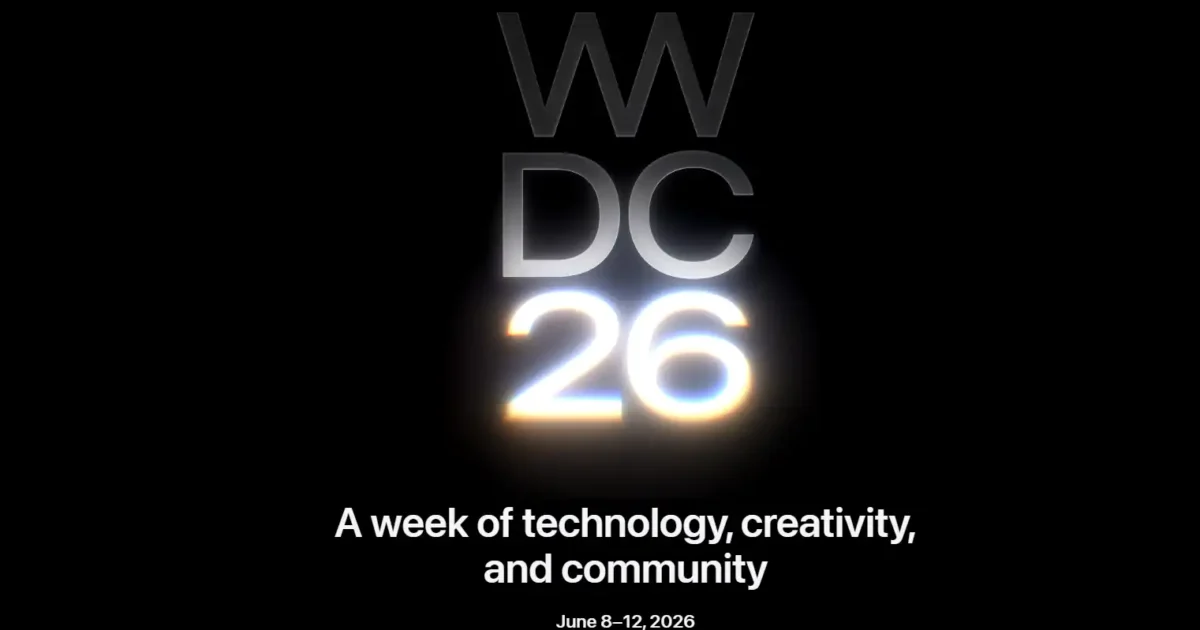
Which is why the WWDC 2026 announcement landed differently than the last few. Dates confirmed: June 8–12, Apple Park, Cupertino. Keynote at 10 a.m. Pacific. That part is routine. What’s less routine is the language Apple chose — “AI advancements,” stated plainly, right at the top. Last year’s WWDC barely touched AI. The big story was Liquid Glass. The AI stuff got fifteen minutes near the end and most of it had already been announced. Something has shifted.
There’s a particular kind of frustration that builds slowly. You ask your phone something reasonable — pull up the last message from your sister, or figure out why your calendar is double-booked — and it either misunderstands you, opens a browser, or just gives up. That’s been Siri for years now.
WWDC26 will spotlight incredible updates for Apple platforms, including AI advancements and exciting new software and developer tools — Apple, March 23, 2026
The Siri problem, as plainly as I can say it
Siri is not good. I know that sounds blunt, but after fifteen years of incremental updates, it still can’t reliably handle a two-part question. It can’t remember context from ten seconds ago. It occasionally — and this still baffles me — just doesn’t respond at all and then vibrates twice like it’s thinking about it. Bloomberg ran a piece a while back where engineers inside Apple described the underlying codebase as essentially unreformable without starting from zero.
Which is, apparently, what they’re doing. The internal project is reportedly called “Campos.” A completely rebuilt Siri 2.0 — conversational, context-aware, able to move across multiple apps in a single session without resetting. Think less “current Siri” and more “ChatGPT you can talk to, except it can actually open your Messages app and do something.” Whether Campos ships in June or gets quietly delayed to iOS 28, I can’t say for certain. But the direction is clear.
The backend deal is the part that surprised me. Apple has reportedly agreed to pay Google around a billion dollars a year to use Gemini AI as the intelligence layer underneath whatever the new Siri becomes. Apple routes it through Private Cloud Compute and on-device processing, so — theoretically — Google never touches your data. That’s the pitch. Whether you trust it is, honestly, a separate conversation.
What most iPhone users care about is simpler: can I ask this thing to reschedule my dentist appointment and trust that it will actually do it? That bar has not been cleared in fifteen years of Siri. It needs to clear it this year.
iOS 27 — honest expectations
Every few years Apple ships what the industry informally calls a “tick” — a maintenance year, focused on cleaning up rather than dazzling. iOS 27 looks like one of those. Better battery logic, fewer background processes quietly draining performance, smoother feel on devices that are two or three years old. The kind of update that doesn’t make headlines but absolutely changes how the phone feels six months in.
Multitasking — real side-by-side windows on iPhone — is apparently coming, but it’s tied to the iPhone Fold announcement, which isn’t expected until fall at the earliest. So it may land at WWDC 2026 and then sit there, technically announced, practically unusable, for most people for six months. Apple does this. It’s frustrating. It’s also just Apple.
Liquid Glass stays. Refinements are coming. If you were hoping it would disappear entirely — it won’t. The redesign is now the baseline, and iOS 27 builds on it.
What Apple is expected to announce at WWDC 2026
iOS 27 · iPadOS 27 · macOS 27 · watchOS 27 · tvOS 27 · visionOS 27. Developer betas go live immediately after the keynote. Public betas follow in July. General release lands in September.
The developer story, which matters more than most coverage suggests
Apple already moved Claude and OpenAI’s Codex into Xcode as AI coding agents earlier this year. Quietly. No big announcement, just a change that developers noticed because suddenly there was third-party AI living inside Apple’s core development environment. The old Apple would never have allowed that. The CoreAI framework — replacing CoreML, the plumbing under most on-device Apple Intelligence features — is reportedly rebuilt from the ground up for the scale of models Apple is now deploying.
That’s not branding. That’s infrastructure changing. Developers building intelligence features this year are going to be building on different ground than they were in 2024.
There are also persistent hardware rumors — new Mac mini, new Mac Studio — attached to WWDC 2026. I’d treat those as possible but unconfirmed. What does look confirmed is that macOS 27 will drop support for a chunk of older Intel Macs. The 2017–2018 Intel machines that have held on through multiple cycles are likely at the end of the road. If that’s you, this is the year to start planning.
Why WWDC 2026 is different from the last three
Apple has been in an uncomfortable position for about two years. The company that built the best hardware on the market has been losing the “which phone is actually smarter” argument — to Samsung, to Google, to a growing pile of AI-native apps that do in one tap what Siri fails at in three voice commands. Apple Intelligence launched at WWDC 2024 with real fanfare and then arrived in pieces, some features delayed indefinitely, some quietly shelved. Then 2025’s WWDC went deep on visual design while the AI backlog kept growing. The developers I’ve spoken to haven’t been angry, exactly. Just tired.
This conference has to deliver. Not because Apple says it will — they’ve said that before — but because there is no longer a comfortable “we’ll get there eventually” framing available. The narrative has shifted. People now genuinely ask whether an iPhone is smarter than a Pixel. In 2019 that question would have seemed absurd. In 2026 it comes up at dinner.
Apple can’t afford another year of “coming later this fall.”
The in-person developer lottery closes March 30. Notifications go out April 2. The whole thing streams free on YouTube, the Apple Developer app, and Apple’s website. If you build anything with intelligence features, the afternoon session tracks are where the real information lives — the keynote sets the narrative, but the sessions tell you what the APIs actually do.
Siri had better work this time. I’d really like to stop texting my husband about flight gates.

No comments yet. Be the first to share your thoughts!