
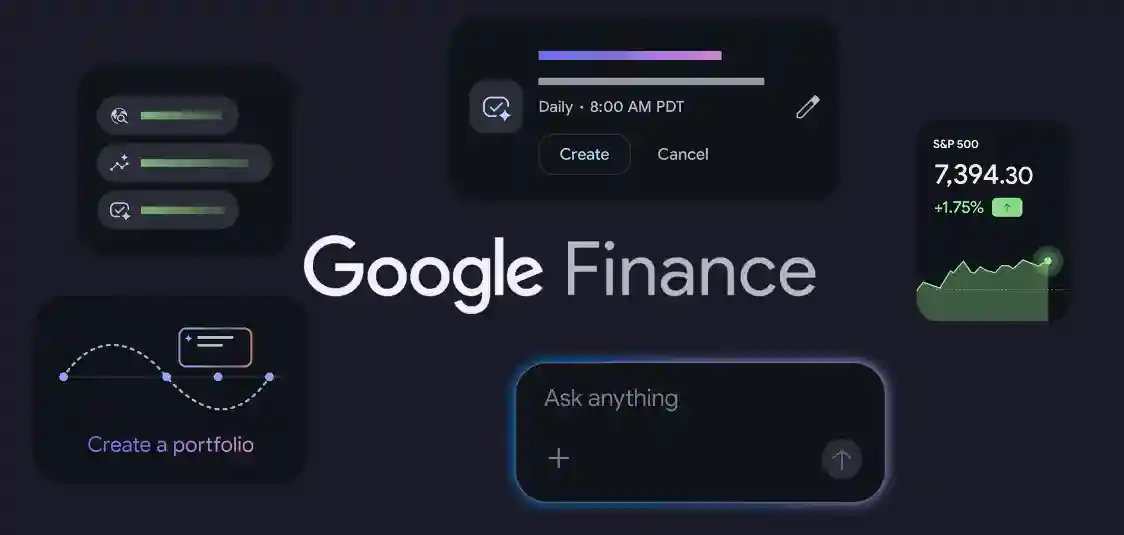

On June 25, 2026 Google Finance launched a dedicated Android app and simultaneously exited its ten-month beta, shipping portfolio tracking, scheduled AI market briefings, and a native mobile presence for the first time since Google killed its Finance app in 2015.
What the Google Finance Android App Ships With Today
The app is live on the Play Store now. At launch: watchlist, real-time market data, live financial news feed, the AI research tool, and Key Moments.
Key Moments is the one worth your attention. It’s an AI-powered overlay that explains why a stock moved on a given day — contextual annotation directly on the price chart, not a follow-up search. If you’ve ever stared at a 4% drop and opened three tabs to figure out what happened, that’s the problem it solves.
Portfolio tracking and scheduled AI briefings — the headline features — are web-only at launch. Both are coming to mobile “over the coming months,” per Google. Live earnings calls are on the same deferred list.
The 2015 Gap, Closed
Google removed its standalone Finance app from the Play Store in 2015. For eleven years, anyone who wanted Google Finance on Android got a browser tab or a Search results card — neither built for someone checking pre-market futures at 6 AM. That vacuum filled with Robinhood, Yahoo Finance, and Bloomberg. None of them have Gemini baked into the research layer.
The AI-powered rebuild began in the US in August 2025, reached India in November 2025, expanded to 100+ countries in April 2026, and exits beta today with an app in hand.
Portfolio Tracking And Why the Setup Matters
Portfolio management rolls out globally on the web this week. Single dashboard, performance data, asset allocation insights. Existing Google Finance portfolios carry over automatically.
New portfolio creation is where this separates from the field. You can upload a CSV or PDF, drop in a brokerage screenshot, or just describe your holdings in plain language and let the AI build from there. Once it’s set up, you can ask the research tool: “What sectors are currently underrepresented in my portfolio?” or “How does my fixed income allocation impact my long-term growth potential?”
Compared to Yahoo Finance — which requires manual ticker entry or brokerage OAuth — Google wins on day-one friction. Yahoo still leads on transaction history and cost-basis tracking. Google’s target user is whoever has a Schwab account and has never bothered to configure portfolio tracking anywhere because setup was annoying.
Scheduled AI Briefings Don’t Underestimate This
You write a plain-language instruction. Google runs it on a schedule. Example from Tee’s post: “Send me a daily premarket briefing analyzing significant overnight moves across major cryptocurrencies.”
The briefing lands in your Google app or Finance research panel. No subscription required — unlike some Google AI features currently gated behind AI Pro or AI Ultra, the scheduled briefings are available to anyone with a Google account.
The practical ceiling is prompt quality. “Give me market updates” gets you something worse than Yahoo Finance’s free homepage. A specific, well-scoped instruction gets you something that’d cost $30/month on a Bloomberg terminal alternative. That delta is entirely on the user.
Where This Sits in the Market
Google is not offering trading or brokerage services. Finance is an information and research layer — no order execution, no custody. That keeps it out of securities regulation territory and means it doesn’t compete with Robinhood (which now runs AI agents that execute trades autonomously).
Yahoo Finance remains the benchmark for free portfolio tracking. Bloomberg is in a different tier entirely.
The real edge here is the AI research layer on personal holdings. No other free app lets you ask natural-language questions about your own portfolio and get reasoned answers back. If model quality holds, that’s a genuine differentiator — not a marketing claim.
Google Finance vs. Yahoo Finance: Feature Comparison
| Feature | Google Finance | Yahoo Finance |
|---|---|---|
| Price | Free | Free (ads) / Gold: $39.95/mo |
| Portfolio setup | CSV, PDF, screenshot, or plain-language description | Manual ticker entry or linked brokerage |
| AI research tool | Yes — Gemini, natural language queries on your holdings | Yes — Yahoo Scout (Gold plan) |
| Scheduled briefings | Yes — free, custom natural language tasks | No |
| Stock chart annotations | Yes — Key Moments (AI explains price moves) | No direct equivalent |
| Live earnings calls | Web only (coming to mobile) | Yes — AlphaSpace (Gold plan) |
| Brokerage sync | No | Yes |
| Transaction history / cost basis | No | Yes |
| Mobile app | Android now, iOS later 2026 | Yes (Android + iOS) |
| Ad-free | Yes | No (free tier is ad-supported) |
What’s Still Coming
Three features are still missing from mobile: portfolio tracking, scheduled AI briefings, and live earnings calls — all due in the coming months. The iOS app is later in 2026, no date set.
The live earnings calls feature is the one to watch. Google already offers live audio, synchronized transcripts, and AI-generated highlights on the web if that lands on mobile intact, it approximates something Bloomberg charges hundreds of dollars a month to replicate.

No comments yet. Be the first to share your thoughts!