
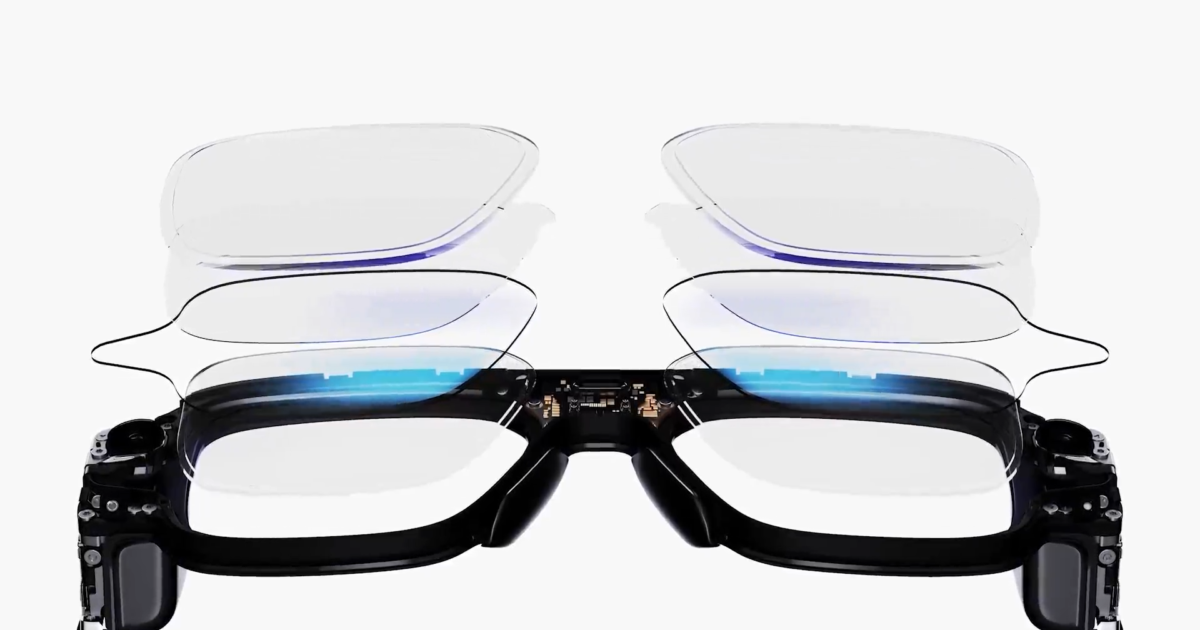

The SPECS AR glasses specs full picture is now public. Snap CEO Evan Spiegel unveiled them June 17, 2026, at Augmented World Expo in Long Beach, California ending years of developer-only hardware. SPECS AR glasses announced 2026 carry a 51° FOV, dual Snapdragon processors, a 132g frame, and a $2,195 price. This Snap SPECS AR glasses analysis breaks down every confirmed number, flags what Snap has not yet disclosed, and compares the device directly against Apple Vision Pro.
SPECS AR Glasses Announced at Augmented World Expo 2026
Snap did not arrive at AWE 2026 without ammunition. The company holds 7,000+ AR-related patents and has spent over $3 billion on AR research across approximately a decade (UploadVR, June 17, 2026). Every prior Spectacles generation, three developer editions fed engineering data into this product. June 17, 2026 is the date that investment went consumer.
Spiegel described Specs as “a new type of computer, a see-through computer” (Engadget, June 17, 2026). That framing matters. Snap is not positioning this against Ray-Ban Meta. The target is a device category that does not yet exist at scale.
SPECS AR Glasses Full Specs: Technical Breakdown
Skip the hype and the idealized 3D renders. Here is the raw, confirmed data on what these glasses actually pack inside
Display: 51° FOV, 16M Colors, Liquid Crystal on Silicon
51 degrees. That is the field of view 30% larger than fifth-generation Spectacles (Road to VR, June 17, 2026). The display uses liquid crystal on silicon (LCoS) inside Snap’s proprietary waveguide architecture, rendering 16 million colors. Snap describes the visual equivalent as a 24-inch desktop monitor for productivity and a 115-inch cinema screen for video. The waveguide contains billions of nanostructures more than 10,000 etched per hair-tip width.
SPECS AR glasses 51 degree FOV is confirmed. Display resolution, peak brightness in nits, and refresh rate remain undisclosed.
Weight & Design: 132g Frame, Swiss TR90 Polymer
Two frame sizes are available. The 47mm frame weighs 132g; the 52mm weighs 136g (Wareable, June 17, 2026). SPECS AR glasses 132 grams weight is achieved through Swiss TR90 polymer, a high-performance thermoplastic used in premium optical frames for its tensile strength relative to mass. Removable prescription inserts accommodate a wide range of corrections without custom lenses.
The lenses are electrochromic — the same technology used in Boeing 787 Dreamliner windows, cited directly by Snap (Snap Newsroom, June 17, 2026). They shift from fully clear to tinted in 10 seconds, adapting automatically as you move between indoor and outdoor environments. This is meaningfully faster than photochromic alternatives like Meta Ray-Ban Display’s Transitions lenses, which take approximately one minute to adjust — and unlike photochromic lenses, electrochromic tech functions through UV-blocking glass, including car windshields
For context: Ray-Ban Meta glasses weigh ~50g. Apple Vision Pro weighs 600–650g. Specs occupy a weight class with no direct competitor.
Processors: Dual Snapdragon, Split-Task Architecture
Two Qualcomm Snapdragon chips, each assigned a distinct workload. One handles computer vision, spatial awareness, fast hand tracking, and environment mapping. The other runs AR Lenses, Snap’s on-device augmented reality layer (Road to VR, UploadVR, June 17, 2026). No external computer. No phone required.
The SPECS AR glasses Snapdragon processors use a split architecture specifically because unified-chip AR glasses have historically degraded under simultaneous vision and rendering loads. Specific Snapdragon model designations were not announced.
Battery: 4-Hour Mixed Use, 20 Hours with Charging Case
Four hours of mixed use audio, video, active Lenses, AI processing, Bluetooth per Spiegel’s direct statement at AWE (Tom’s Guide Live, June 17, 2026). The charging case provides four additional full charges on the go. SPECS AR glasses battery life of 4 hours extends to a 20-hour total day with the case. The case is a portable battery, not merely protective storage.
Latency: 7ms Motion-to-Photon
7 milliseconds. Motion-to-photon latency measures the gap between a physical head or hand movement and the display updating to reflect it verified through Snap’s robotic measurement systems (UploadVR, June 17, 2026). The accepted comfort threshold for AR is below 10ms; above it, users report visual drift and motion discomfort. SPECS AR glasses 7ms latency clears that threshold.
SPECS AR Glasses Price: $2,195 With $200 Refundable Deposit
The $2,195 refundable deposit SPECS structure works as follows: $200 is charged at pre-order and is fully refundable; the remaining $1,995 is billed when the glasses ship. Pre-orders are live now at specs.com. No subscription. No developer program gate.
SPECS is simultaneously the most expensive smartglasses product on the market and the cheapest standalone see-through AR computer available (Engadget, June 17, 2026).
SPECS vs Apple Vision Pro: Spec Comparison
| Feature | SPECS AR Glasses | Apple Vision Pro |
| FOV | 51° | ~100° |
| Weight | 132g (47mm) / 136g (52mm) | ~600–650g |
| Price | $2,195 | $3,499 |
| Battery | 4 hrs (20 hrs with case) | ~2 hrs (external battery) |
| Processors | Dual Snapdragon | Apple M2 + R1 |
| Form factor | Glasses | Headset |
| Prescription | Removable inserts + electrochromic adaptive tint | Specialty Zeiss lenses |
| Social use | Transparent lenses | Isolating display |
The fundamental difference is presence. Vision Pro removes the wearer from the physical world. SPECS keeps them in it.
SPECS AR Glasses Developer Ecosystem: Lens Studio
Hundreds of Lenses are already published ahead of consumer launch. SPECS AR glasses Lens Studio developers now have access to three new toolsets: an agentic development workflow with MCP support for Claude Code, Cursor, and Codex Snap’s term for OpenAI’s code-generation tooling, reflecting OpenAI’s modern GPT-4o and o1-class model architecture rather than the legacy standalone Codex API (MacRumors, UploadVR, June 17, 2026); a SPECS Spatial Benchmark for hardware performance testing; and a Migration Agent for porting existing Lens projects to Specs.
At the OS level, Snap OS integrates directly with OpenAI and Gemini on Google Cloud. This is not a local-only AI stack. Published Lenses can call live OpenAI and Gemini APIs in real time, enabling multimodal experiences that respond to what the glasses see, hear, and track (Snap Newsroom, MacRumors, June 17, 2026). Real-time language translation and contextual AR overlays shown at AWE both draw on this cloud AI layer.
The Native Development Kit accepts C and C++, targeting spatial mapping, physics engines, positional audio, and navigation. Three Lenses demonstrated at AWE: Drum Kit (interactive percussion lessons in real space), Vector Fields (making invisible electromagnetic and gravitational forces visible as overlays), and a golf green-reading tool that maps slope and break lines in real time.
SPECS AR Glasses Privacy: LED Indicator, On-Device Processing
The privacy LED activates when recording begins. It is hardware-enforced, not a software flag any app can suppress. On-device processing is the default mode. Snap states the glasses request explicit permission before accessing sensitive environmental context, and users retain full control over what is stored, synced, or deleted (Snap official, June 17, 2026). The SPECS AR glasses privacy LED recording system was architected at the chip level, not patched in afterward.
SPECS AR Glasses Shipping: Fall 2026 in US, UK, France
SPECS AR glasses fall 2026 shipping is confirmed for three markets: the United States, the United Kingdom, and France. No precise date within fall 2026 has been set. No regional expansion beyond those three countries has been announced. Pre-order at specs.com $200 secures your place in the queue.

No comments yet. Be the first to share your thoughts!