
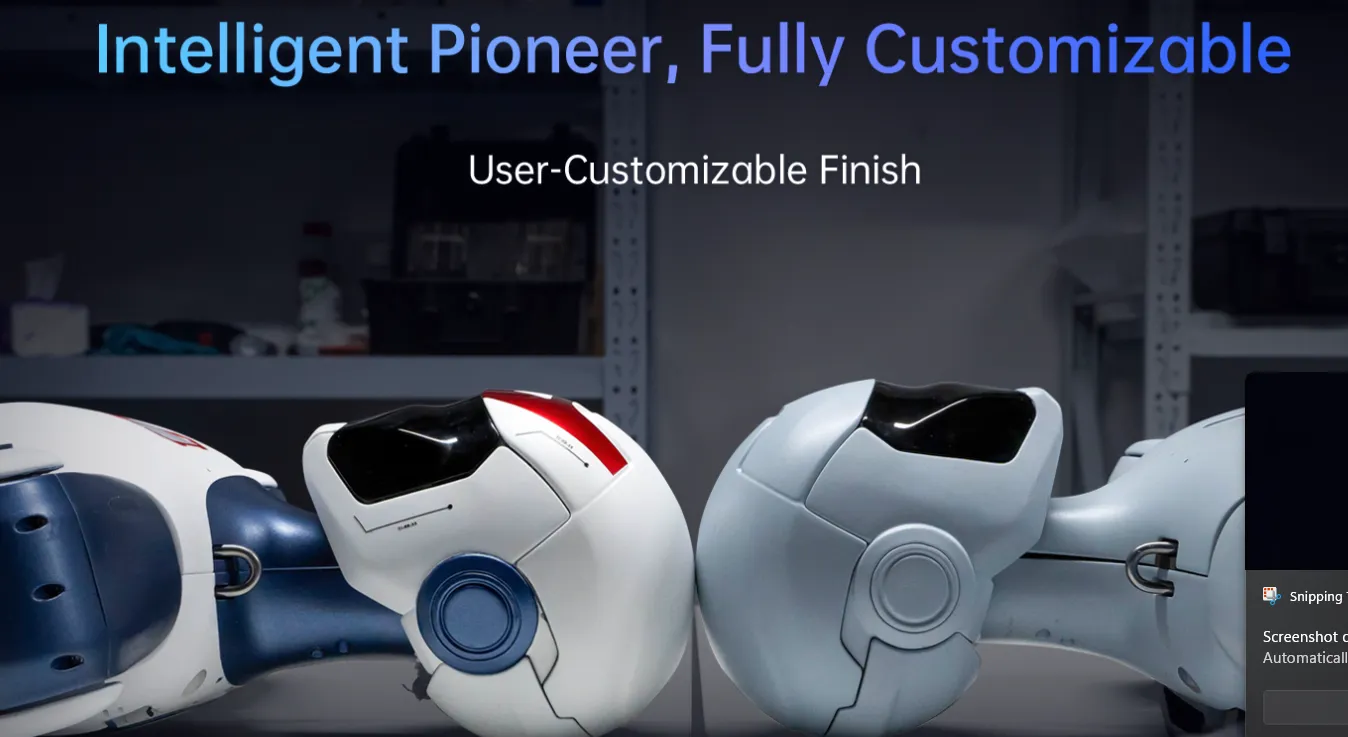

The Unitree R1 is a small humanoid robot built around movement, not household chores. Unitree lists the R1 Air from $4,900 and the standard R1 at $5,900 before tax and shipping. That price is what made the robot interesting, but it is not the whole story. The model you choose changes the camera, number of joints, development support, and weight, so the headline figure needs some unpacking.
This guide separates the confirmed specifications from the impressive demonstration videos. It also explains who the R1 makes sense for, what the consumer versions cannot do, and which details to check before placing an order.
What is the Unitree R1?
The R1 is a compact bipedal humanoid platform from Unitree Robotics. It stands about 123 cm tall and weighs roughly 27 to 29 kg, depending on the version. Unitree sells an R1 Air with 20 degrees of freedom, a standard R1 with 26, and an EDU line with more configuration and development options.
That distinction matters. The standard R1 is not simply a cheaper version of a full research robot. Unitree’s shop says the consumer R1 does not support secondary development; buyers who need that capability should ask about the EDU version. In other words, the R1 can be a fun and capable physical platform without automatically being an open robotics kit.
Unitree R1 price and versions
- R1 Air: Unitree lists it from $4,900. It has 20 degrees of freedom, a simpler camera setup, and a lighter configuration.
- R1: Unitree lists the standard model at $5,900. It has 26 degrees of freedom, a binocular camera, and the more complete body configuration.
- R1 EDU: Contact sales for pricing. This is the version to investigate if you need secondary development, optional computing hardware, or education and research features.
Those prices exclude shipping, taxes, and import charges. Unitree’s shop also warns that shipping can vary substantially by destination. A buyer in India, the UK, or the US should treat the listed dollar amount as the starting price, not the final delivered cost. Ask for the exact configuration and a landed quote before comparing it with another robot.
Unitree R1 specs that actually matter
The specification sheet is long, but a few entries have a direct effect on what the robot can do.
- Degrees of freedom: The standard R1 has six joints per leg, five per arm, two in the waist, and two in the head. The Air removes some of those joints and has 20 in total.
- Computing: The platform uses an 8-core high-performance CPU. Unitree lists NVIDIA Jetson Orin options for the EDU configuration, not as a universal feature of every consumer R1.
- Sensing: Depending on the model, the robot has a monocular or binocular camera, a four-microphone array, speakers, Wi-Fi 6, and Bluetooth 5.2.
- Battery: Unitree lists battery life at about one hour. Actual runtime will depend on movement, computing load, and how often the robot performs demanding actions.
- Size and handling: At about 123 cm tall and close to 29 kg in the standard configuration, the R1 is smaller than an adult but not light enough to treat like a toy.
How agile is the Unitree R1?
Unitree’s videos show the R1 performing cartwheels, handstands, running movements, punches, and quick transitions from the floor. Those demonstrations explain the product’s identity better than the word “humanoid” does: this is a movement-first machine. Its appeal comes from balance, joint control, and the ability to move through a human-shaped body.
There is an important line between a demonstration and a dependable product capability. A successful clip does not tell us how many attempts were needed, how much supervision was involved, or how the robot behaves after months of use. It also says nothing about carrying objects, navigating cluttered homes, recovering from unexpected contact, or working safely around children and pets.
That is not a criticism unique to Unitree. Humanoid robots are difficult machines. They combine powerful motors, a tall centre of mass, software, cameras, batteries, and moving joints in one body. Anyone operating an R1 needs a clear area, a safe distance, and a willingness to accept that a demo move is not a promise of autonomous everyday service.
Can the R1 do household tasks?
Do not buy the R1 expecting a robot that can reliably vacuum, cook, fold laundry, or manage a home without supervision. Unitree presents the R1 as a humanoid platform with voice and image capabilities, but the company does not turn those features into a promise of general-purpose domestic autonomy.
Voice interaction can make a robot easier to operate. It does not automatically give the robot the planning, dexterity, safety awareness, or reliability needed for chores. The same applies to a camera: seeing an object is much easier than grasping it, knowing whether it is safe to move, and completing the task without damaging something nearby.
R1 vs G1: what changes?
The R1 is smaller, lighter, and cheaper than Unitree’s G1. That does not make it a direct replacement. The G1 is aimed more squarely at research and industrial experimentation, while the R1 lowers the entry cost for people who want a compact humanoid platform. The table below is useful as a quick orientation, but model configurations and regional prices can change.
| Feature | Unitree R1 | Unitree G1 (2024 model) |
| Price | From $4,900; R1 listed at $5,900 | From about $13,500 |
| Weight | About 29 kg (standard R1) | About 35 kg |
| Degrees of Freedom | 20 Air / 26 standard | Varies by version |
| Target Users | Developers and education; EDU for secondary development | Research and industrial users |
| Agility | Movement-focused demonstrations | More established larger platform |
The comparison should not be read as a laboratory performance ranking. A robot’s usefulness depends on its software, hands, sensors, payload, support, and the task being attempted. A lighter body may help agility, while a larger platform may offer more room for batteries, sensors, and stronger hardware.
Who should consider buying the Unitree R1?
The R1 makes the most sense for robotics students, developers working on locomotion, educators building demonstrations, and enthusiasts who already understand that humanoid hardware requires care. It can also be useful for a lab that wants a relatively accessible platform for testing movement ideas.
It is a poor fit for someone who wants an appliance. The purchase includes more than the robot itself: you may need a suitable operating space, transport, spare parts, software knowledge, a safe storage plan, and time to learn the controls. If you need to write your own low-level software, confirm that you are buying the EDU model before paying.
What to check before ordering
- Confirm whether the quote is for R1 Air, R1, or R1 EDU.
- Ask whether the selected model supports secondary development.
- Get the final shipping, tax, customs, and import estimate for your country.
- Check the included camera, battery, controller, charger, and computing hardware.
- Read the warranty terms and ask how repairs and replacement parts are handled in your region.
- Plan a safe operating area. Unitree warns that humanoid robots have powerful moving parts and should be used with sufficient distance.
Unitree R1 FAQ
How much does the Unitree R1 cost?
Unitree lists the R1 Air from $4,900 and the standard R1 at $5,900 before tax and shipping. The EDU model requires a sales quote.
How long does the R1 battery last?
Unitree lists battery life at about one hour. Heavy movement and computing can change actual runtime.
Does every R1 support programming and secondary development?
No. Unitree’s shop says the consumer R1 does not support secondary development. Contact Unitree about the EDU version if that is a requirement.
Final verdict
The Unitree R1 is interesting because it makes a moving humanoid robot less expensive to approach, not because it has solved the hard parts of household robotics. The price is real, the movement demonstrations are eye-catching, and the compact body could make the platform useful in classrooms and labs. The trade-offs are just as real: short battery life, safety concerns, configuration differences, limited consumer development support, and extra delivery costs.
If you want a platform for learning, experimenting, and studying bipedal movement, the R1 deserves a closer look. If you want a robot that quietly handles chores while you get on with your day, this is the wrong product category.
Source: Unitree’s official R1 specifications. For another robotics story, see our Insta360 Antigravity A1 Drone coverage.

No comments yet. Be the first to share your thoughts!