
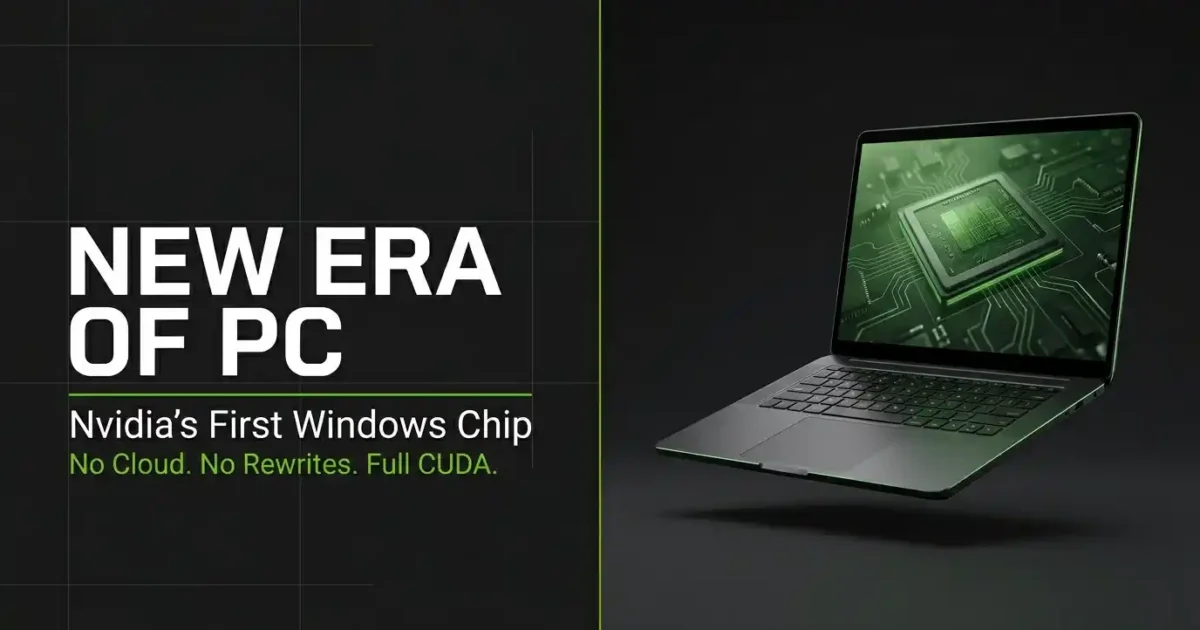

May 29, 2026. Nvidia, Microsoft, and Arm posted the same four words simultaneously on X: “A new era of PC.” Coordinates followed 25.0528, 121.5990 the Taipei Music Center. Jensen Huang’s stage. June 1. This is not a tease. It is a countdown.
The chip is the N1X, a 20-core ARM SoC co-developed with MediaTek, built on TSMC’s 3nm node, carrying 6,144 Blackwell CUDA cores in a unified die alongside up to 128 GB LPDDR5X memory. Nvidia’s first laptop CPU. Three years in design since 2023. The Computex 2026 Nvidia PC announcement ends that wait publicly, on livestream, at 11:00 a.m. Taipei time June 1.
When Will the First Nvidia-Powered Windows PC Launch?
Keynote: June 1. OEM press briefings: same afternoon. Computex floor demos: June 2. Dell’s XPS N1X reveal carries a May 31 embargo date per VideoCardz. Lenovo’s internal product database leaked in May 2026, confirming N1X models already in production queues. Asus and MSI follow.
Retail hits pre-holiday 2026. No street date confirmed. Entry pricing lands above $1,400 per analyst estimates Nvidia does not compete on budget.
Which Devices Will Feature Nvidia Chips?
Microsoft Surface Nvidia chip integration is confirmed by Axios and Reuters pre-launch reporting. The Nvidia ARM PC processor footprint at launch covers Dell XPS, Lenovo (eight models leak-confirmed), Asus, and MSI. The Dell Nvidia Windows PC specs memory configuration, TDP, display tier remain embargoed. DigiTimes places all four OEMs on the Computex floor June 2 with hardware in hand.
Nvidia’s ARM-Based PC Processor: Technical Architecture Breakdown
The N1X is one die. CPU and GPU on TSMC 3nm, no inter-chip PCIe bus, no discrete VRAM pool. That architecture has direct consequences.
What’s inside:
- 10× Cortex-X925 performance cores + 10× Cortex-A725 efficiency cores
- 48 Blackwell streaming multiprocessors, 6,144 CUDA cores
- Up to 128 GB LPDDR5X unified memory shared CPU/GPU pool
- Dedicated on-die NPU
- Full CUDA 12.x stack: TensorRT, cuDNN, the entire Nvidia software ecosystem
Nvidia vs Qualcomm ARM Windows laptop: Snapdragon X Elite runs Oryon cores. No CUDA. No Blackwell. Qualcomm’s HTP NPU requires proprietary SDK rewrites for every inference pipeline. The N1X ports existing CUDA workloads without modification. That gap is not marginal, it is categorical.
Nvidia vs Intel Windows laptop: Arrow Lake ships separate CPU and iGPU dies. No integrated configuration approaches 6,144 shader cores. x86’s variable-length instruction encoding carries decode overhead ARM’s fixed-width ISA eliminates at the architectural level.
Nvidia ARM processor Windows battery life gains come from three compounding factors: 3nm switching capacitance reduction, elimination of inter-die PCIe power draw, and efficiency cores absorbing ambient workloads. Independent validation is pending.
Hard ceiling: shared LPDDR5X bandwidth sits at 273 GB/s. Discrete GDDR7 exceeds 700 GB/s. Tom’s Hardware estimates N1X delivers roughly 20–25% of discrete RTX 5070 sustained AI throughput. The N1X is not a workstation replacement. It is a laptop-class device with workstation-class memory headroom.
AI Agents Running Locally on Windows: What the N1X Actually Enables
Microsoft Build 2026 (June 2–3, San Francisco) ships the Windows Agent Runtime an OS-native layer that runs AI agent Windows PC local execution with folder-scoping and mandatory network-deny policies enforced at the kernel level.
Current Copilot+ PCs hit Azure for any model above 7B parameters. Network drop kills the task. The N1X’s 128 GB pool fits 13B–70B models entirely in memory. Agents run offline. No API logs. No egress billing. WSL 3 with NPU passthrough gives Linux ML containers direct hardware access, something Snapdragon X cannot offer today.
Nvidia PC vs Apple M5 MacBook: The Actual Tradeoffs
Apple’s M5 MacBook launched March 2026 at $1,099 $300+ below estimated N1X entry pricing. Same TSMC 3nm node. Four years of ARM-native macOS optimization. Near-total app compatibility. Independently validated battery benchmarks.
The N1X counters with 128 GB memory versus Apple’s 64 GB ceiling, and the CUDA ecosystem. PyTorch CUDA backend, TensorRT pipelines, RAPIDS none require rewrites. The M5 demands MLX or CoreML migrations for identical workloads. That is a real switching cost for AI developers.
Price and software maturity go to Apple. Memory ceiling and CUDA compatibility go to Nvidia. Pick based on your toolchain, not the spec sheet.

No comments yet. Be the first to share your thoughts!