
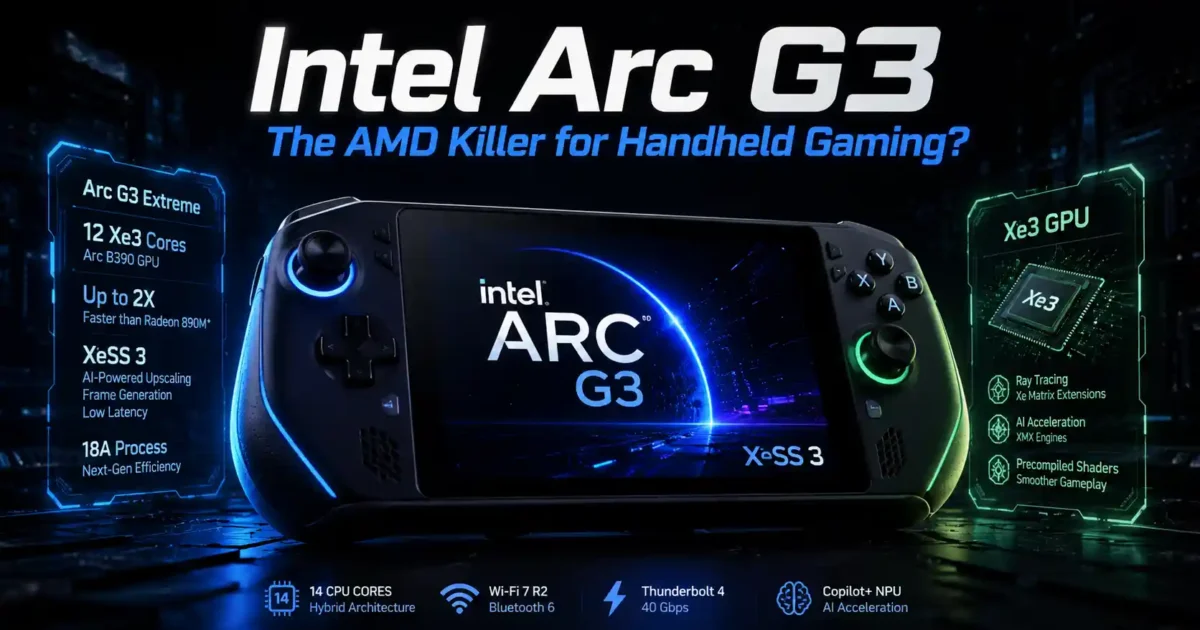

Today Intel announces the Arc G3 and Arc G3 Extreme the first Intel Arc G3 handheld gaming PC processors built from scratch for portable play, not laptop chips running at reduced power limits. First devices ship June 2026. The real question: does Intel actually compete here, or is this just a Computex press release dressed up in handheld clothing?
Intel Arc G3 vs Arc G3 Extreme Specs and What Separates Them
Both chips share the same CPU core layout. Fourteen cores total two high-performance P-cores handle the heavy game logic, eight efficiency cores run background tasks, four ultra-low-power cores keep the system ticking in menus and light workloads. Intel built both on the same 18A manufacturing process powering its Core Ultra Series 3 laptop chips.
The GPU is where they split. Arc G3 Extreme packs a fully enabled Arc B390 GPU 12 Xe3 graphics cores, higher clock speeds, marginally higher peak power draw. Arc G3 standard drops to Arc B370 10 Xe3 cores, lower performance ceiling, but better thermal headroom in tight handheld chassis.
Both support XeSS 3 Intel’s AI upscaling combining super resolution, multi-frame generation, and Xe Low Latency. Both include a Copilot+ certified NPU, Wi-Fi 7 R2, Bluetooth 6, and Thunderbolt 4 at 40 Gbps. Intel also baked in precompiled shader support on the G3 Extreme specifically designed to eliminate the micro-stutters that plague PC games when entering new areas.
Intel Arc G3 vs AMD Ryzen Z2 Extreme Honest Performance Picture
Intel’s own numbers put the Arc B390 GPU at up to twice the performance of AMD’s Radeon 890M, the GPU inside the Ryzen Z2 Extreme, which currently powers the best AMD handhelds on the market.
Twice is a significant claim. It’s also Intel’s claim, not an independent lab result.
The honest caveat every buyer needs: Intel measured that performance gap at higher power settings. Real handhelds run constrained. Smaller heatsinks, tighter thermal limits, battery requirements all narrow the gap between what a chip does in a benchmark and what it does sitting in your hands on a train. The real-world difference will be smaller than the spec sheet implies.
What holds regardless of which benchmark you trust: AMD’s current handheld GPU runs on RDNA 3 architecture, which is several years old. AMD hasn’t shipped RDNA 4 in any handheld chip yet. Intel’s Xe3 is current generation silicon. That structural advantage is real and it’s the reason this announcement matters.
If you want context on how Intel’s chip strategy has been evolving, we covered the Intel-Nvidia partnership impact earlier this year worth reading alongside this one.
First Intel Arc G3 Handheld Gaming PCs Three Confirmed Devices
MSI Claw 8 EX AI Plus MSI has been Intel’s main handheld partner since the original Claw. This generation runs the Arc G3 Extreme with 32GB LPDDR5X RAM. Already listed online before the official announcement. Pricing unconfirmed 32GB RAM in a handheld suggests it won’t be budget-friendly.
Acer Predator Atlas 8 8-inch display, 120Hz VRR, 1200p IPS panel, Arc B390 or B370 depending on configuration. Acer targets October 2026 for this one. Predator branding means expect premium pricing.
OneXPlayer Specifics still thin ahead of Computex 2026, where Intel says full details drop. OneXPlayer has a loyal following among US handheld enthusiasts, so this one will get attention the moment specs land.
Intel confirmed all three at its official announcement with full details at Intel Newsroom.
For comparison on how Samsung handles the same Intel 18A chips in a laptop form factor, see our Samsung Galaxy Book6 coverage same chip architecture, very different thermal envelope.
Can Intel Arc G3 Handheld PCs Run SteamOS?
Right now SteamOS officially ships on AMD hardware only. Valve hasn’t confirmed Intel Arc G3 support.
But SteamOS 3.8 preview specifically mentioned improved Intel-based system support and included fixes targeting the MSI Claw. Valve isn’t doing that work accidentally. Whether SteamOS runs cleanly on brand-new Arc G3 silicon at June launch is a separate question; new chips typically need driver work before a Linux OS handles them properly.
Committed to SteamOS, AMD is still the safer bet right now. Fine with Windows 11 and Xbox Mode, which Intel actively supports on these chips, Arc G3 devices are a real option the moment they ship.
Should You Buy an Intel Arc G3 Handheld Gaming PC?
Buying a handheld today the ROG Ally X with Ryzen Z2 Extreme is still the known quantity. Reviewed, available, understood. Arc G3 devices don’t ship until June at the earliest, with most models arriving later in 2026.
Willing to wait until fall, a fully reviewed MSI Claw 8 EX AI Plus will tell you whether Intel’s performance claims hold outside controlled demos. That’s the moment the buying decision actually makes sense.
Already own a Steam Deck or older Claw, not enough of an upgrade to justify cost unless AMD releases RDNA 4 handheld chips and forces a genuine generational comparison.
Intel Arc G3 is the most serious challenge to AMD’s handheld dominance since the category launched. Whether it wins that fight depends on thermals, pricing, and driver stability none of which get confirmed until reviewers have hardware in hand.

No comments yet. Be the first to share your thoughts!