
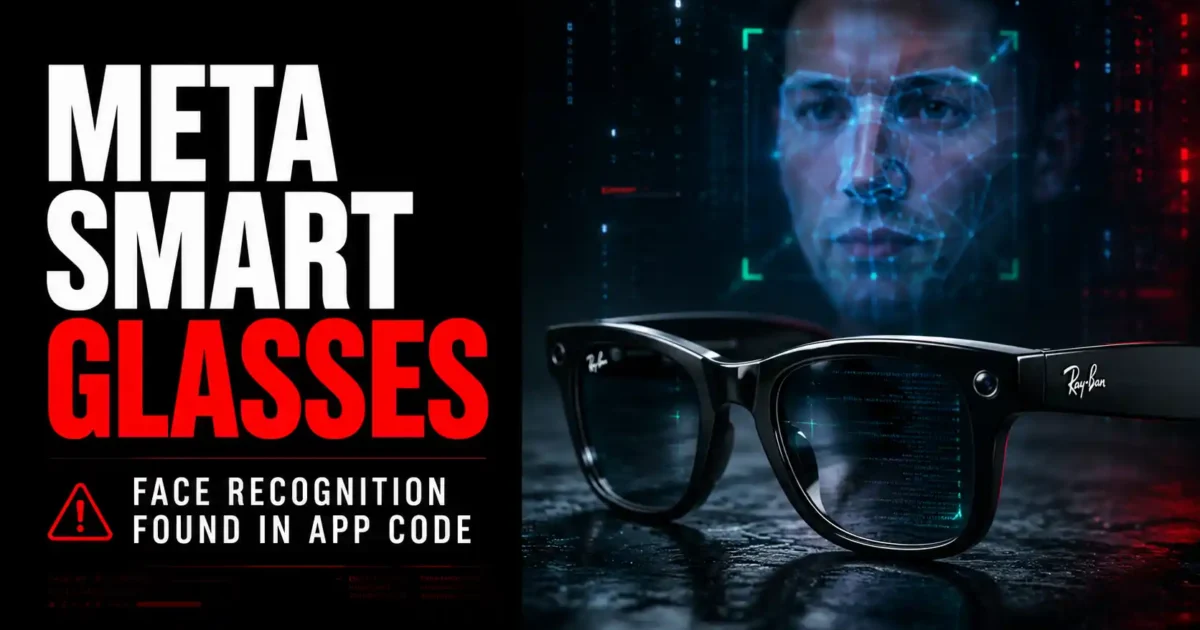

Meta smart glasses face recognition infrastructure is already sitting on 50 million phones. WIRED’s investigation found active NameTag code embedded inside the live Meta AI app — not in a test build, not in a staging environment. Shipped. Distributed. Waiting.
Meta Smart Glasses Face Recognition: What WIRED Found
Reverse engineers don’t lie. The NameTag feature — Meta’s smart glasses face recognition system — exists as functional, non-disabled code inside the Meta AI application currently installed across 50 million+ US devices. This isn’t a roadmap leak or a patent filing. It’s production-deployed software.
Meta’s own statement: “Nothing has shipped to consumers.” The code disagrees.
The Ray-Ban Meta smart glasses privacy concerns this triggers aren’t hypothetical. A user wearing Ray-Ban or Oakley Meta glasses running NameTag could, in principle, identify strangers in real time by cross-referencing biometric faceprints against Meta’s social graph. That’s the mechanism. No speculation required.
WorksHow Meta Smart Glasses Face Recognition Works
Meta’s approach is architecturally distinct from a standalone facial recognition app. The smart glasses camera feeds visual data to on-device or edge processing models. NameTag then matches extracted facial geometry — what Illinois BIPA law calls a “biometric identifier” — against profile data accessible through Meta’s identity systems.
The opt-in vs opt-out facial recognition question is where the real danger lives.
Meta Reality Labs privacy documentation has historically described NameTag as opt-in. But code being pre-deployed to 50 million devices before any consumer consent mechanism is visible suggests the opt-in architecture isn’t built yet — or isn’t prioritized.
Distributed surveillance machine is not hyperbole here. It’s a technical description of what Ray-Ban Meta glasses face recognition becomes at scale: millions of ambient cameras, each capable of silent biometric capture, all networked to the same identity infrastructure.
2021 to 2026: Meta Did This Before
Meta killed facial recognition in 2021. They deleted over a billion faceprints, citing privacy concerns, and framed it as a values-driven decision.
Five years later, Meta buried the same capability in app code, reframed it differently, and attached it to a hardware product that makes the surveillance vector fundamentally harder to avoid. You can decline to use Facebook. You cannot opt out of a stranger’s glasses.
The Meta facial recognition sunset 2021 vs 2026 comparison exposes the pattern: Meta introduces a capability, backlash hits, Meta shelves the feature, then quietly resurfaces it in a different product category where social norms haven’t caught up to the technology.
70 Organizations Are Not Staying Quiet
The ACLU, alongside 69 other privacy and civil liberties organizations, sent a formal demand to Meta: scrap NameTag entirely. Not delay it. Not audit it. Remove it.
The coalition’s core argument targets Meta smart glasses privacy invasion at the systemic level — one person wearing connected glasses can identify every face in their field of view without a single identified person ever consenting to biometric capture.
Privacy advocates oppose Meta’s framing that this is just another opt-in feature. The opt-in model assumes the subject of identification has agency. Bystanders don’t.
US Legal Exposure Is Real
Illinois Biometric Information Privacy Act. Texas Capture or Use of Biometric Identifier Act. Two statutes with private rights of action and per-violation damages that have already cost Meta over $1.4 billion in Facebook photo-tagging settlements.
NameTag, deployed without explicit informed consent architecture, walks directly into that legal minefield. California’s CPRA creates additional exposure around the processing of sensitive personal information — and biometric faceprints qualify.
No “this is experimental” disclaimer insulates a company from BIPA liability once code processes biometric data at scale.
Check Your Settings Now
Open Meta AI app → Settings → Privacy → Face Recognition. If the toggle exists and is enabled, disable it. If you see no toggle, Meta hasn’t yet consumer-activated the feature — but the underlying model still sits on your device.
Meta’s infrastructure for Meta smart glasses face recognition is staged and ready. Meta hasn’t flipped the switch publicly. When they do, 50 million devices won’t need an update. They’re already loaded.

No comments yet. Be the first to share your thoughts!