
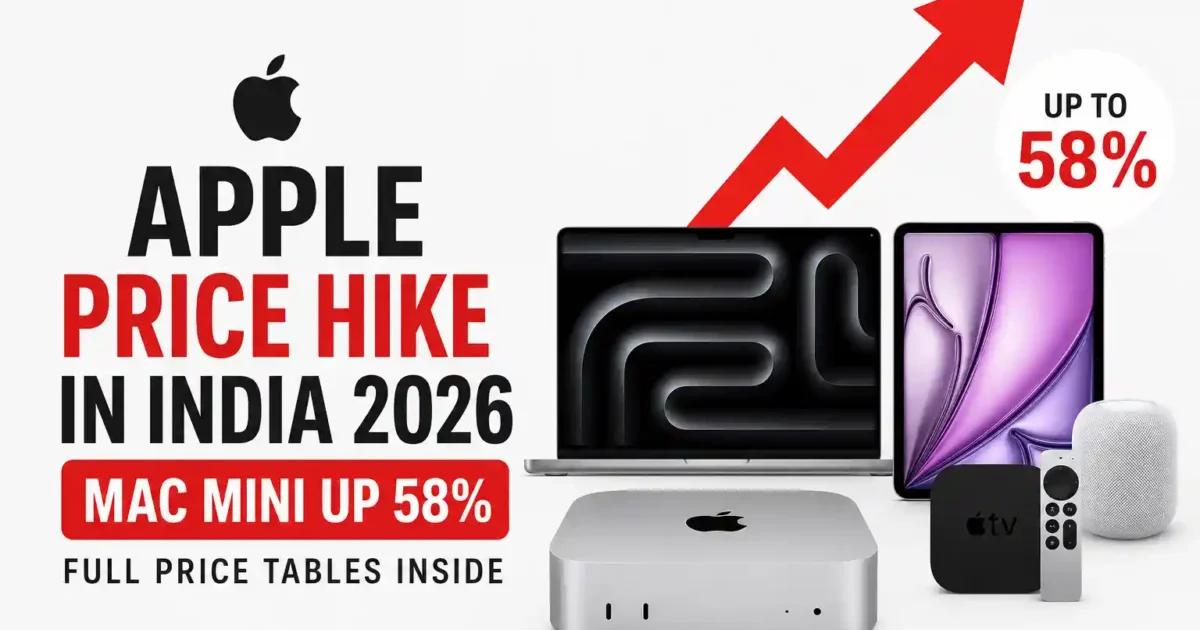

Apple raised prices on Mac, iPad, Apple TV, and HomePod models in India on June 25, 2026. The Apple price hike India 2026 story runs as high as 58% on the Mac mini, roughly double to triple the size of the increases Apple pushed through in the US. The 256GB Mac mini is the steepest mover, up from ₹59,900 to ₹94,900.
The 14-inch MacBook Pro is up 41%. The MacBook Air 13-inch is up 25%. Every iPad model is up 38% to 43%. In the US, the same wave of hikes mostly landed in the high teens to mid-20s. Part of the gap traces to something Apple hasn’t put in a press release: it has quietly dropped the roughly 1 USD = 100 INR conversion rate it used for years to set India pricing.
What Apple Announced on June 25, 2026
Apple’s India website began reflecting new prices on June 25, hitting Mac, iPad, Apple TV, and HomePod. Free Press Journal and IBTimes India were among the first outlets to publish full price lists; both confirmed the iPhone lineup was untouched.
In a statement, Apple said: “We know this is not welcome news.” The company added that the consumer electronics industry is facing component cost increases unlike anything it has seen before, and that it had shielded customers from the increases for months before deciding it could no longer absorb them alone.
Mac Prices in India: Old vs New (Full Table)
The 256GB Mac mini takes the single biggest hit, in percentage terms, of any product in this round. Confirmed pricing, per Free Press Journal, IBTimes India, and GSMArena:
| Model | Old Price | New Price | Change |
| MacBook Neo (8GB/256GB) | ₹69,900 | ₹79,900 | +14.3% |
| MacBook Air 13” (M5, 512GB) | ₹1,19,900 | ₹1,49,900 | +25% |
| MacBook Pro 14″ (M5, 16GB RAM) | ₹1,69,900 | ₹2,39,900 | +41.1% |
| Mac mini (M4, 256GB) | ₹59,900 | ₹94,900 | +58.4% |
Apple’s India site hadn’t listed updated iMac or Mac Studio pricing as of publication, and none of the outlets that broke this story carried numbers for either line worth flagging rather than guessing at. If the entry laptop is what you’re after, read our full guide to the MacBook Neo before the next round of hikes complicates the math.
iPad Prices in India: Old vs New (Full Table)
Every iPad model moved by 38% or more:
| Model | Old Price | New Price | Change |
| iPad (A16, 128GB) | ₹34,900 | ₹49,900 | +43% |
| iPad mini (128GB) | ₹49,900 | ₹69,900 | +40.1% |
| iPad Air 11″ (M4, 128GB) | ₹64,900 | ₹89,900 | +38.5% |
| iPad Pro 11″ (M5, 256GB) | ₹99,990 | ₹1,39,900 | +39.9% |
The 13-inch iPad Air moved even further in percentage terms Oneindia put the base model at ₹84,900 rising to ₹1,19,900, a jump of more than 41%.
Apple TV & HomePod Prices in India
Apple’s smart-home and streaming hardware got the same treatment. Per Free Press Journal’s price list: Apple TV 4K (64GB) went from ₹14,900 to ₹25,900, a 74% jump, the steepest percentage increase in the entire announcement. The 128GB Apple TV 4K rose from ₹16,900 to ₹31,900. HomePod climbed from ₹32,900 to ₹44,900. HomePod mini went from ₹10,900 to ₹15,900. Apple Vision Pro isn’t on any of these lists. It has never launched in India.
The Hidden Hike: Apple Quietly Raised BTO Upgrade Pricing in India
There’s a second increase buried in Apple’s online configurator. GSMArena flagged it first: memory and storage build-to-order upgrades, which used to step up in multiples of ₹20,000, now cost ₹24,000 per step. Higher-capacity storage options jump in ₹30,000 increments. Anyone customizing a MacBook or Mac mini at checkout pays more than the headline price suggests and pays more per upgrade tier than they would have a week earlier.
Why India Got Hit 3x Harder Than the US
Two things compound here. Apple’s global price increases for this wave ran roughly 15% to 25%-plus in the US, per newsletter AI Risk and Return’s reporting citing Bloomberg and The Verge; the MacBook Neo alone went from $599 to $699, a 16.7% rise. India’s increases mostly cleared 25%, with the Mac mini and several iPads passing 40%.
The bigger factor is the one Apple hasn’t acknowledged publicly: GSMArena reported that Apple dropped the roughly 1 USD = 100 INR conversion rate it had used for India pricing for years. That conversion quirk is gone, and the new math doesn’t appear temporary even if global memory prices ease later, the rupee-to-dollar relationship that kept India’s sticker prices roughly proportional to the US no longer applies.
Why Did Apple Raise Prices? The AI Memory Crisis Explained
Blame the data centers. DRAM and NAND prices have roughly quadrupled over the past year as Google, Microsoft, Meta, and Amazon lock up memory supply for AI servers, according to multiple outlets covering CEO Tim Cook’s mid-June interview with The Wall Street Journal. “This is a 100-year flood,” Cook told the paper, saying he’d never seen a commodity swing like it in four decades in electronics supply chains.
Micron’s latest quarterly numbers back that up: $41.5 billion in revenue, non-GAAP EPS of $25.11, and a gross margin near 85% up from the high teens a year earlier, per the company’s fiscal Q3 2026 results. High-bandwidth memory revenue topped $10 billion for a second straight quarter.
Micron has guided investors to expect tight supply through 2027, easing only in 2028. Counterpoint Research’s Neil Shah told PTI that Apple had absorbed most of the cost increase for months before this round of hikes.
Is It a Bad Time to Buy a MacBook or iPad? (Buyer’s Guide)
Not necessarily but waiting now has a real cost. Micron’s own guidance points to tight memory supply through 2027, which gives Apple little reason to roll prices back next quarter. If a specific configuration has more RAM, more storage is non-negotiable, locking it in at today’s price beats betting on a correction that may not come.
If your current Mac or iPad still does the job, there’s less urgency: the heaviest increases hit configurations with bigger memory and storage footprints, not entry-level units, and Apple hasn’t signaled a second India-specific hike is imminent. Comparison shoppers might also want to see the best MacBook alternatives under ₹1 lakh in India before committing to the now-pricier lineup.
The Bigger Picture: What This Means for Apple’s India Growth Story
India is still the growth story Apple wants to tell. Morgan Stanley has pointed to India contributing around 15% of Apple’s revenue growth and 20% of its installed-base growth over five years, with the business scaling toward sevenfold within a decade though that forecast predates this week’s price hikes.
The iPhone wasn’t touched, and that’s not incidental: the phone line drives more than half of Apple’s global revenue, per India IPO’s reporting. Counterpoint has flagged a risk that hasn’t materialized yet iPhone pricing could be next if memory costs don’t ease. Read our explainer on the AI memory chip shortage for more on what’s driving all of this.
Frequently Asked Questions
Final Verdict: Apple Just Quietly Made India a Premium-Only Market
The Apple price hike India 2026 story isn’t really about memory chips. That part is happening everywhere. It’s about India absorbing a currency reset, a BTO repricing, and a steeper baseline hike in the same week, while the US got only one of the three. A Mac mini that cost ₹59,900 a month ago now costs ₹94,900. An iPad that cost ₹34,900 now costs ₹49,900. Track every Apple India price move on our Apple hub as this develops because if Counterpoint’s read on iPhone risk is right, this won’t be the last one.

No comments yet. Be the first to share your thoughts!